

LIANZA 2025 Conference Highlights
Adrian Jenkins, Te Whare Wānanga o Wairaka – Unitec
‘Sustain and Change’ was the call to Aotearoa New Zealand library and information workers gathering at the Tākina Convention Centre in Wellington for the LIANZA 2025 conference. What a call, what an opportunity.
It had been several years since I had attended the LIANZA conference. Funding limitations led me to do most of my professional development online. When the opportunity to apply for a Regional Contestable Conference Grant arose, I excitedly applied and was thrilled to receive it.
Despite the unpleasant weather in Te Whanganui a Tara, I was ready to go. How was my knowledge going to grow? What tips would I learn? Who was I going to reconnect with or meet for the first time? I learned many new things:
- How prison libraries run in a variety of security settings and how they are dependent on donations and withdrawn books from libraries for their library collections. And that prisoners are not allowed to use the Internet.
- That Artificial Intelligence (AI) has been a concept for over 50 years, and that Reddit is the most common source of information for ChatGPT responses.
- That the New Zealand Legal Information Institute (NZLII) and Courts of New Zealand websites are excellent free sources of information regarding things such as unofficial legislation, Case Law, and rulings from the Supreme and other Courts from 2000 onwards. In addition, a new Open Educational Resource, entitled “Essential Legal Research Skills in Aotearoa New Zealand”, has just been published and is an excellent resource for new law librarians and others engaging with legal questions.
- As a legal librarian, it is important not to advise the customer but rather lead the customer to the correct information for them to make their own decision.
- That librarians outshone themselves to prove that, no, Wellingtonians weren’t being kept awake by the sounds of whales in 1800.
- That the product Keenious has the potential to be a good AI tool for finding quality papers and helping one understand tricky concepts or jargon.
As a tertiary institute librarian, providing access to quality academic information sources is core to my role. The ongoing prevalence of ‘fake research’ is very concerning. I was sad to learn that the ‘publish or perish’ pressure facing some academics is still leading to a proliferation of poor-quality research outputs. ‘Paper mills’ pushing out low-quality papers are still very active. There have been cases where journals published by New Zealand universities have been cloned, and academics in other countries have been charged to publish in the cloned journal even though publishing in the actual journal is free under a Diamond Open Access policy. I was also shocked to discover that some papers with fake authors have been published, in which either no such person exists, or the person exists but knows nothing about the paper.
I was reminded that there are still serious concerns about Māori Data and Māori information ownership/sovereignty, particularly with AI tools. Māori scholars have been submitting on the Wai 2252 claim regarding Māori data sovereignty. A recent publication by the first keynote, Dr Karaitiana Tiauru, is a good summary of the issues. This is an ongoing challenge that non-Māori librarians must engage with. The final keynote, Te Paea Paringatai, backed this up, saying “Neutrality is not an option: we need to elevate indigenous knowledge and customs”.
Stepping outside my academic librarian world, it was interesting to see the new library robot from[AC1]. Bibliotheca and to consider that concerns about information quality and AI tools extend into public libraries as well. I am looking forward to the newly established LIANZA Standing Committee on AI guiding us as we librarians continue to engage in this space. I also talked to librarians from smaller communities about some of their challenges.
On the third day of the conference, I joined Tales & Tours – Tour 1, which visited various local libraries, heritage and information centres. I was fascinated to see the very old materials being curated at the Te Aka Matua Research Library. I also learned about the information access parameters and service expectations here and at the Parliamentary Library. Finally, it was great to examine positive user experience changes made at Victoria University of Wellington.
Returning to the conference theme and paraphrasing Te Paea Paringatai, we need to do more than sustain—we must regenerate. We must centre indigenous knowledge, champion epistemic quality, harness ethical technology and build intergenerational resilience. What a challenging but vital call to all of us in the Aotearoa library and information sector.
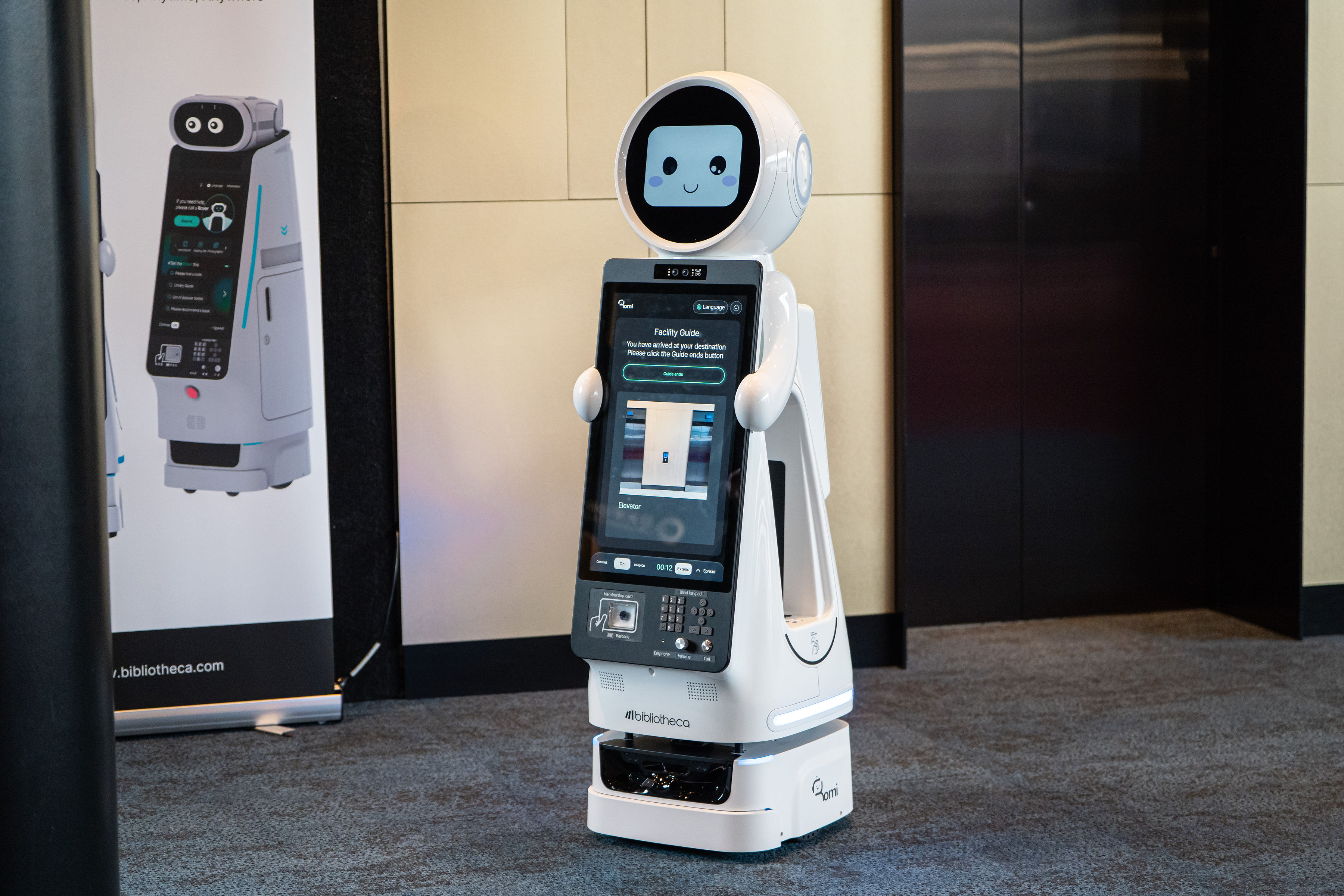
Bibliotheca's new library robot. Image credit: Ahmad Morad.
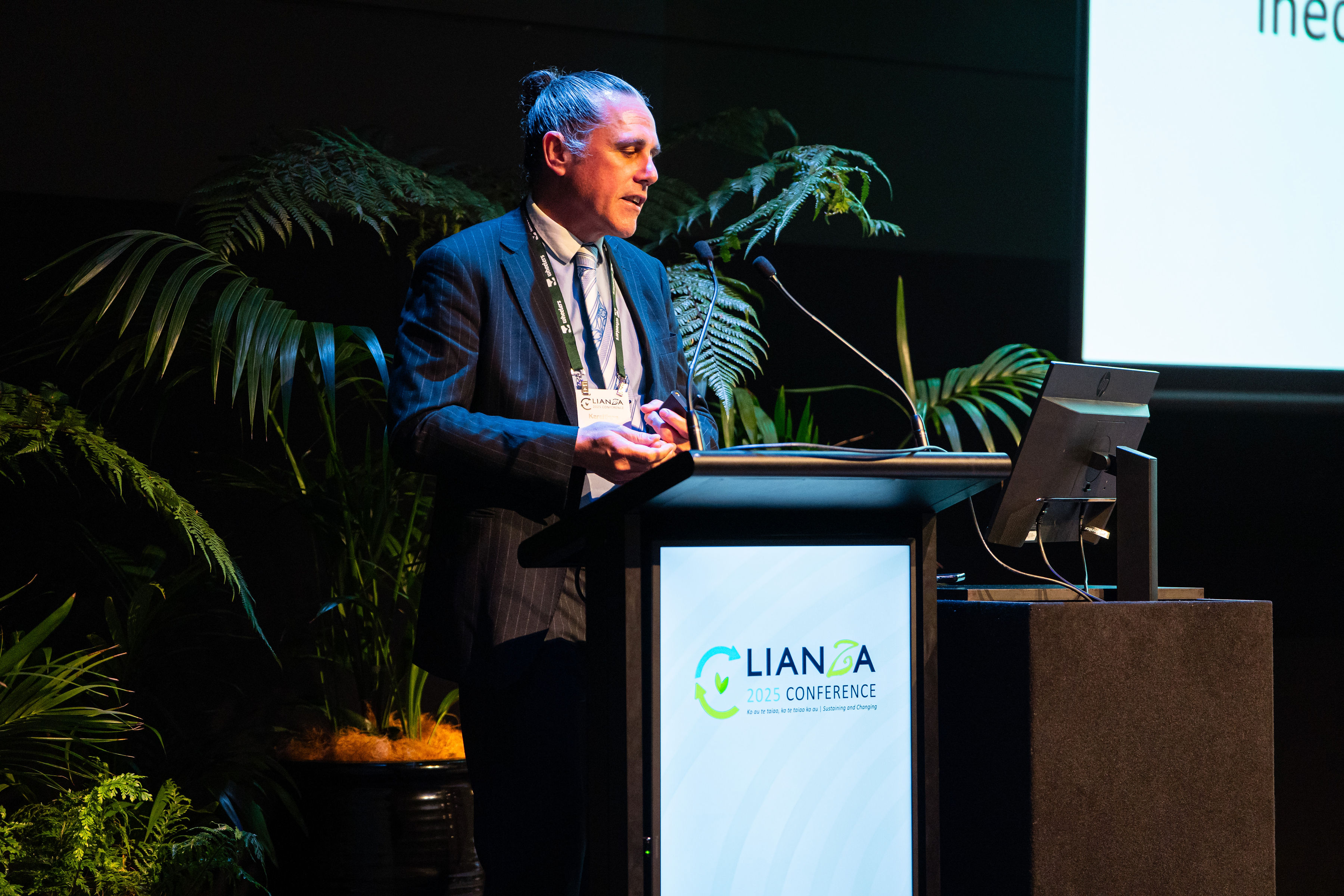
Keynote Dr Karaitiana Taiuru. Image credit: Ahmad Morad.
Bernadette Cassidy, Resource Centre Manager, New Zealand Spinal Trust
Arriving on Monday evening to a wet and windy Wellington, I was grateful to be staying a short walk from the Tākina Convention Centre. Mark Crookston, LIANZA President, opened the conference by acknowledging that the library and information sector needs to adapt to change and respond to the needs of their communities in sustainable ways.
Artificial Intelligence (AI) concerns all library professionals, so there were several very timely presentations starting with the first keynote, Dr Karatianana Taiuru, a leading voice in digital technological ethics and Māori data sovereignty.
Dr Taiuru addressed the crucial issue of ethical and cultural alignment with Māori AI and data. He stressed the importance of aligning AI and data practices with Māori values and principles to prevent bias and discrimination, and to ensure libraries are a trusted source of information. However, the problem is highlighted by the current lack of Māori representation in the tech industry, biases in AI algorithms and a lack of inclusion of Māori AI design and development processes. He recommended having a government, consistent, standardised and centralised approach to Māori data governance grounded in Te Tiriti o Waitangi and customised tikanga Māori solutions.
Keynote Melissa Clark–Reynolds became a futurist and tech entrepreneur after 30 years of experience, including as CEO of several technology companies. Her keynote was thought-provoking and a little unnerving. Some of the takeaways were:
- The most searched website is Reddit, followed by Wikipedia, with Google in third place.
- AI is used in therapy for Gen Z due to waiting lists of six months or more to see a real-life therapist. AI is filling the gaps.
- Volar – an online dating site where you can create an AI of yourself for virtual first dates. The app helps users avoid endless swiping and repetitive "getting to know you" conversations that are common on other apps.
- Gen Zers will have careers we haven’t yet thought of.
- Most new technologies will result in new jobs/careers.
Erin Cairney, chair of LIANZA’s standing committee on AI, spoke about the need for more diverse voices and for toolkits, guides, and resources to ensure that AI is ethical and inclusive.
Growing a nation of readers with Kate de Goldi, Elizabeth Jones and Catherine Leonard. There has been a significant decline in literacy and reading both nationally and internationally, particularly among adults aged 18 – 34. The panel discussed how libraries can be positive role models in sustaining cultural resources. It can’t be left up to schools to deal with this issue. The panel discussed the role of public libraries as reading and literacy partners, not as replicators of what schools are doing. Public libraries face constraints, funding cuts and how relevant they are to their communities. There is an opportunity for all the agencies to work together to integrate technology into public library services and improve the experiences of library users.
Chloe Fryer’s presentation had a personal link as she described the closure of the Leys Institute Library due to earthquake seismic risk. I faced a similar experience with the Allan Bean Centre building, which was deemed unsafe and was demolished in 2015. She discussed the impact on the community, answering their questions and concerns, and their involvement in saving the historical building. Restoration and remediation work on the building should be completed by 2028.
The conference ended with IFLA President-elect Te Paea Paringatai’s interactive keynote on libraries leading a future of collective stewardship. The need to provide equitable access to knowledge (knowledge is a right, not a privilege) and the role of indigenous world views in shaping sustainable solutions.
I manage a small specialist library and have very few opportunities to network with my peers. In addition, the isolated nature of my work environment makes professional development challenging. However, professional development events and conferences, where most of my peers gather in one place, provide me with opportunities to network and learn about important issues and challenges the library profession faces. I am grateful to the LIANZA Contestable Conference Grant for allowing me to attend the LIANZA 2025 conference.
Kay Stodart, Porirua Libraries
SUSTAINABILITY AND AI HOT TOPICS AT LIANZA 2025
Sustainability and AI are two of the hottest topics in the library world at the moment, and the theme of this year's LIANZA conference - Ko au te taiao, ko te taiao ko au: Sustaining and changing - captured them both beautifully.
The conference opened with an insightful keynote by Dr Karaitiana Taiuru on Māori AI and data sovereignty. While many of us know that AI models are being trained using freely available information on the internet and content generated through tools like Google Docs, it was surprising to learn exactly what training data was being used. At the time of the conference, Waitangi Tribunal reports were being used to train AI. However, information and records held in the National Library and Archives NZ’s collections were not. Dr Taiuru also discussed potential risks AI presents for Māori, including replication of bias in training data and incorrect AI-generated metadata. He shared practical steps for protecting mātauranga Māori, introduced a Te Tiriti-focused AI governance model, and offered ethical guidance on using generative AI—many of which he has kindly made available on his blog.
Mandy Henk from Dark Times Academy addressed the role of AI in mis- and disinformation. With the rapid evolution of AI over the past two years, the role of librarians in preventing misinformation is more important than ever. Generative AI has proven its ability to create misinformation and ‘hallucinations’ and has shown to be under the control of disinformation’s ‘bad actors’. Mandy provided bundles of advice. However, what stuck with me (besides the importance of lateral reading) was how to go about countering AI mis- and disinformation: be authentic, be genuine and be there.
Climate-related themes were evident throughout the conference. Sokunthea Nhien from Selwyn Libraries shared what Selwyn Libraries are doing to empower their community with climate knowledge, from programmes and collections to sustainable building design. Simon Christiansen, from Wellington City Libraries, presented on their community outreach success with the kākano seed library and the impact it is having on communities getting involved. Donna Coventry and Judith Gust from AUT shared about the ‘Green Impact’ programme, which encourages individuals to make small, practical and easy lifestyle changes to help the planet - the kind of grassroots sustainability commonly championed by Finnish libraries.
The closing sessions of day two contained further environmental themes. Melanie Johnston shared her master’s research on sustainability in library collection policies, analysing themes in New Zealand Libraries’ policies through the lens of the triple bottom line of sustainability: economic, social, and environmental. Surprisingly, only 20% of the themes she found in library policies related to environmental sustainability. A result she suggested may be attributed to the assumption that environmental sustainability is already ingrained in our practice and does not need to be put into policy.
Johnston’s lightning talk was immediately followed by Matthew Evans' talk on his master’s research on environmental education in libraries. Encouragingly, most library managers recognised sustainability and climate change as important topics today and saw libraries as having a place in environmental education. However, only 26% believed that their libraries were doing enough to provide environmental education services, highlighting a gap between ambitions and action.
A personal highlight for me was co-facilitating a kōrero on climate action in libraries, alongside Alexis McCullough and Sana Saleem from LIANZA’s Standing Committee on Climate Action. Having the opportunity to facilitate dialogue on climate action in libraries was thought-provoking and will help shape my professional practice going forward.
Finally, a huge thank you to LIANZA for the conference grant that made my attendance possible. I would highly recommend applying for a 2027 conference grant, particularly to early-career professionals, as my experience at the conference far exceeded my expectations and provided much-needed professional revitalisation.
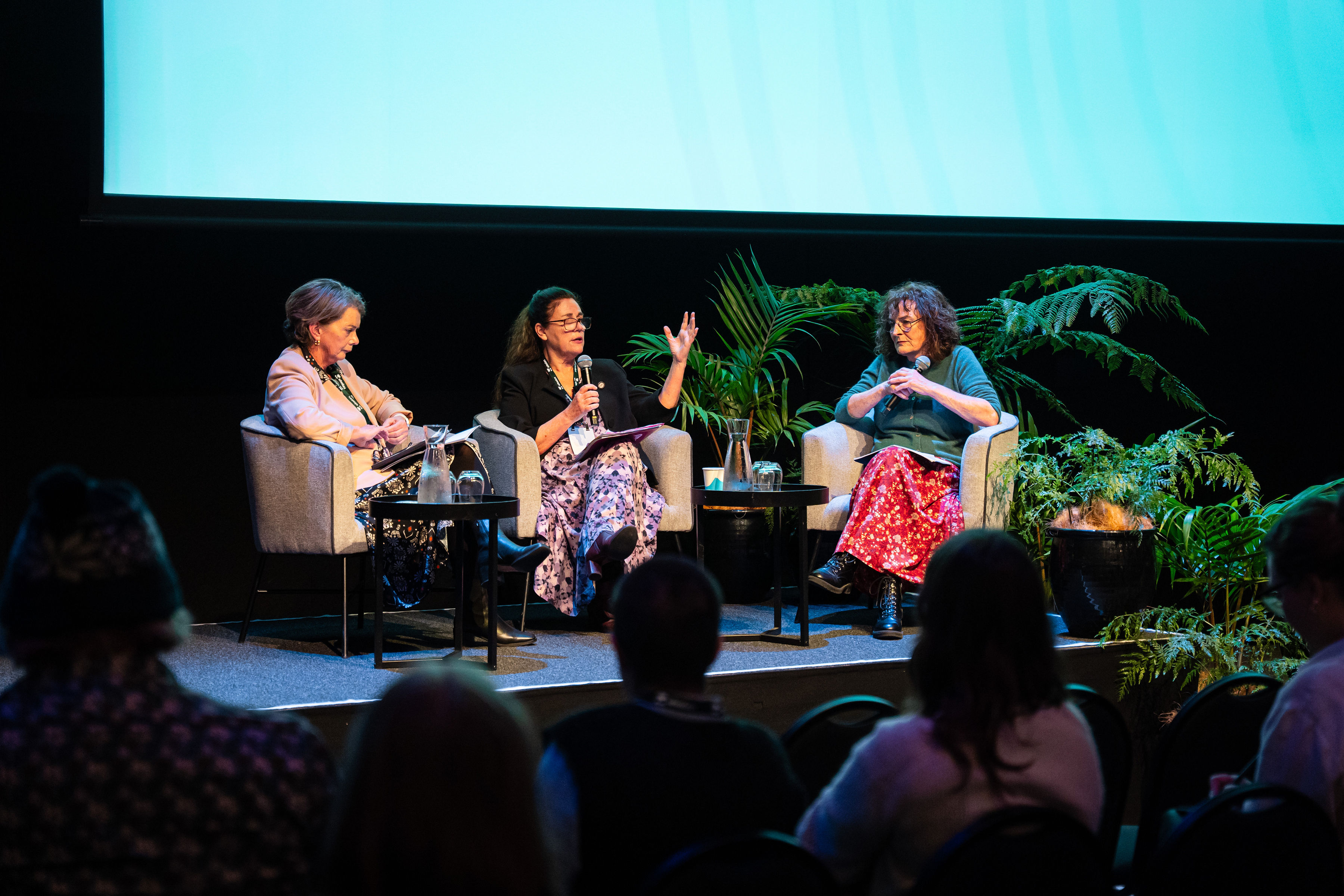
Growing a nation of readers panel with Kate de Goldi, Elizabeth Jones and Catherine Leonard.

Sana Saleem, Kay Stodart and Alexis McCullough co-facilitating a kōrero on climate action in libraries.
Jackie McMillan, Dunedin Public Library
Thank you for selecting me as the recipient of the LIANZA Murihiku Community Conference Grant to attend LIANZA25 in Wellington. This grant meant I was able to cover my airfares from Dunedin and other costs associated with attending the conference.
I thoroughly enjoyed the conference for its breadth of content, including presentations that focused on reading for pleasure and on libraries connecting with their communities in fresh ways, whilst also increasing social connection within those communities. I was impressed by the conference’s overall shape: its well-organised structure with a mix of inspirational keynote speakers, presentations of practical and innovative mahi of LIANZA, for example, the Freedom-to-Read Toolkit, and from a range of libraries. Plus, the library tours on Thursday. The whole conference provided opportunities to network with colleagues across the motu, as well as with vendors who support our industry. It is easy to get isolated from each other, so it was good to come together.
The conference began with a warm welcome on Monday evening in the National Library foyer. Here, I reconnected with many from across the South (aka Murihiku)—it’s a big region! Also, earlier this year, I volunteered to mentor a first timer at the conference. We found each other in the crowd. Well done with matching people! Melanie and I both work in collection development and were also both presenting, so we were able to encourage each other throughout the conference. Mentoring is a great way to bring complete strangers together.
Looking back over my notes, there were themes and links that emerged in many of the lightning talks and papers that stood out to me.
Firstly, collaboration. Libraries initiating projects or new programmes, in partnership with businesses, not-for-profit organisations, other departments within their councils, or individuals in their communities, or maybe all the above. In every case, library-initiated projects were more effective because of collaboration.
One of the best examples was Libraries Horowhenua’s summer reading programme, Read for Trees, which was run in partnership with other departments in their council and an external contractor. Their reading programme was not only revitalised, but they also transformed it from personal reading incentives into a collective contribution to the whenua. I noted that all library staff were prepped and were an essential part of building momentum for the programme and that it was cleverly launched at the Christmas Parade. I also thoroughly enjoyed the plant-related puns throughout their presentation.
Other presentations where collaborative partnerships were key included Auckland Libraries' book buses. Now reaching out to more socially deprived areas, with kai and a cuppa supplied by others. After identifying collection gaps that related to their communities, Auckland began publishing its own books to help these communities share their own stories.
The impact of NZLPP funding three years on was another thread. This, sadly, one-off government investment in the library sector enabled many libraries to start responding to their communities more creatively and responsively, especially regarding literacy levels and digital literacy. Discussion, led by SLANZA representatives in one session and by Kate De Goldi, Elizabeth Jones, and Catherine Leonard in another, looked at the urgent need for all libraries to support each other across the sector and to be recognised as a part of the national conversation about declining literacy levels. The need for public advocacy on the benefits to society of reading for pleasure was noted.
Other take-home messages came from keynotes. Dr Monty Soutar’s faith-filled story behind the book Kāwai: For Such a Time as This provided insight into risk-taking. Te Paea Paringatai, IFLA President-elect, reminded us we are all leaders, even if we aren’t in management, and that good leadership is about stewardship.
I bookended the conference with two other amazing professional development opportunities. On Monday, I was supported by the Otago Literacy Association to attend a full day at the NZLA symposium at Scots College, a librarian in a sea of teachers. And on Friday, I visited the National Children’s Collection and Dorothy Neal White collections with research librarian Mary Skarott, to investigate links to Dunedin’s children’s literature collections.
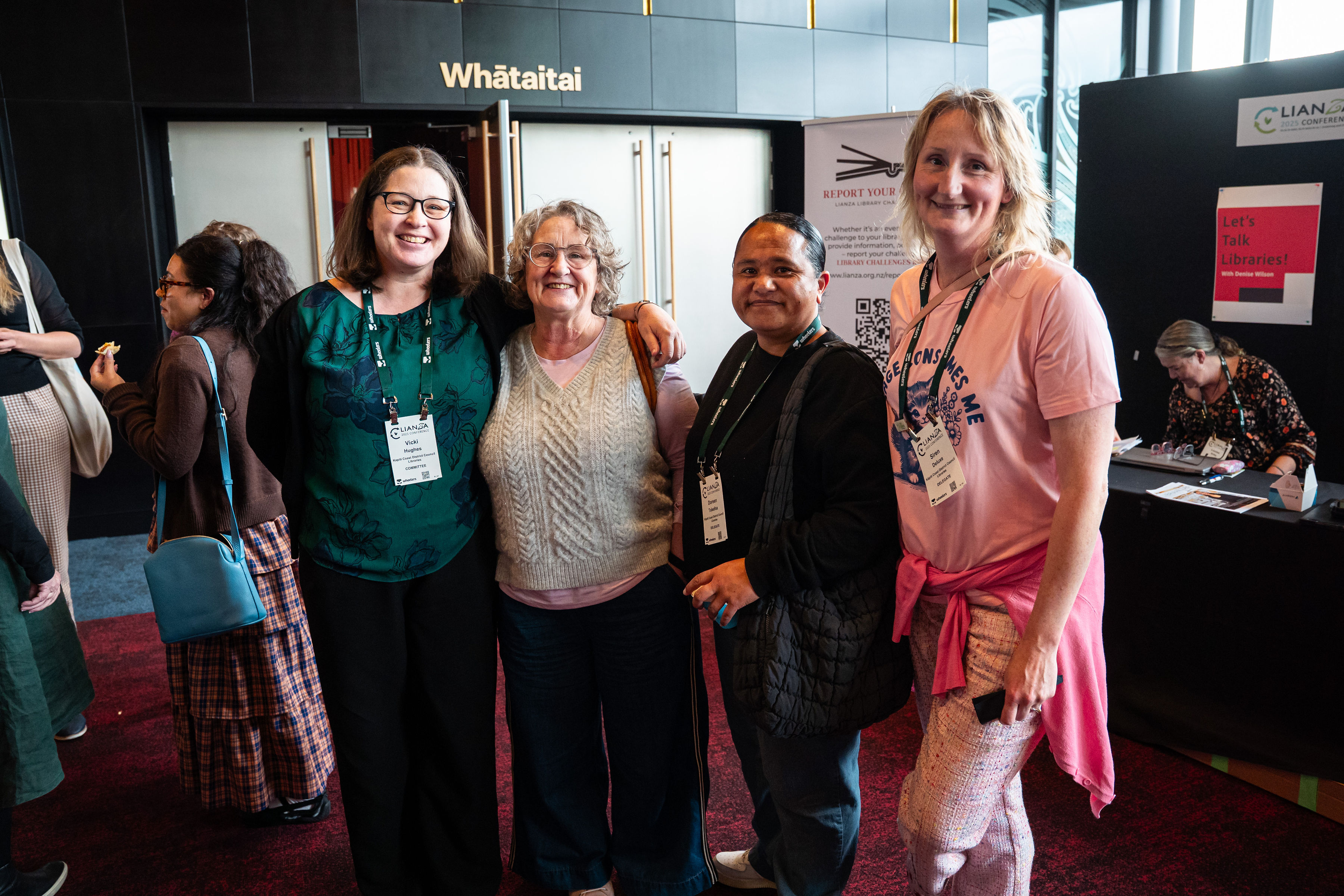
Vicki, Gemma, Doreen and Siren from Kāpiti Coast District Libraries.
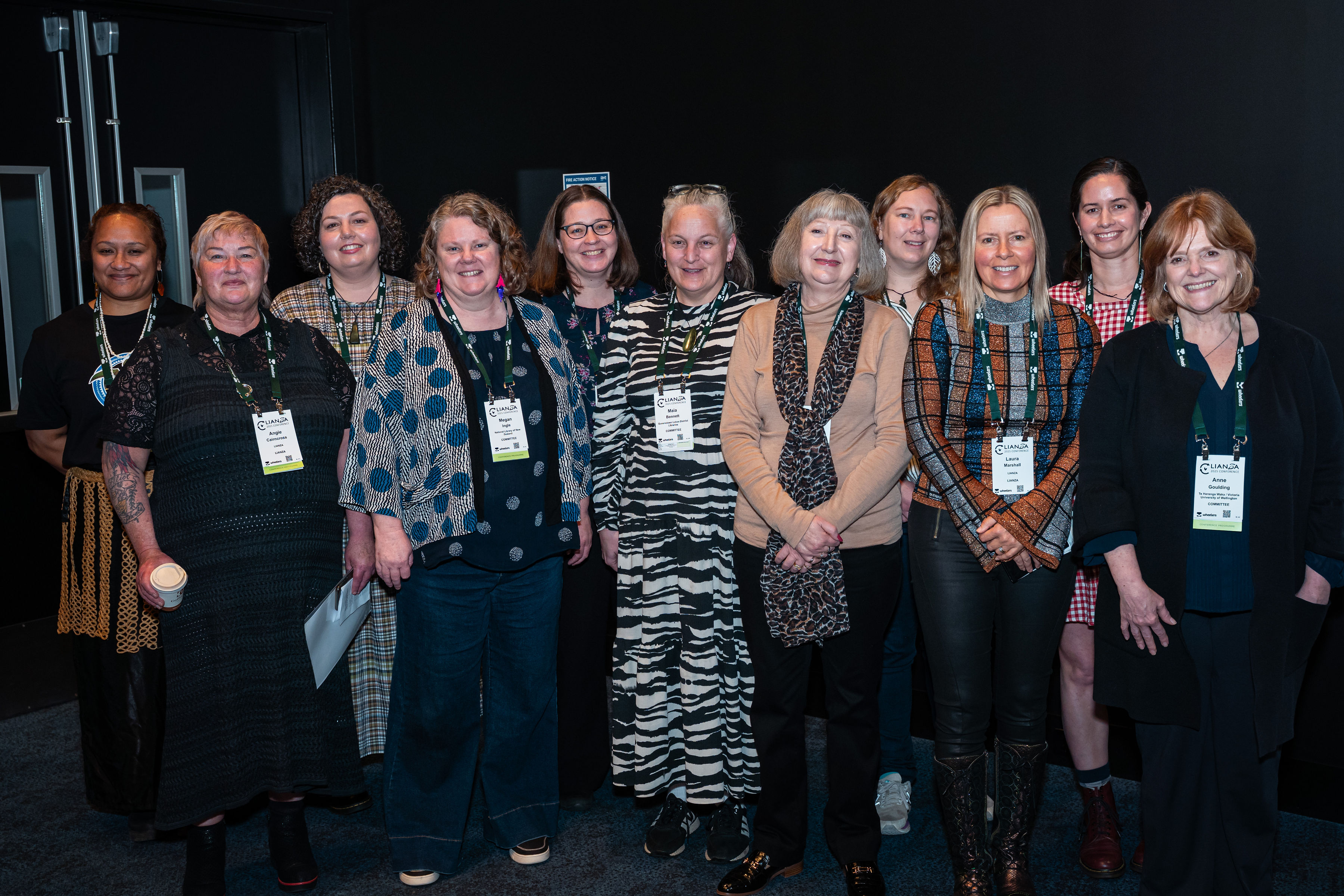
Members of the conference committee.
Chian Ying Ling, Hamilton City Libraries
The LIANZA 2025 conference provides a wonderful opportunity for LIS professionals, educators, and researchers across Aotearoa to discuss current global challenges and share successful approaches applied in libraries. I am grateful to have received the grant and gained valuable insights that will support me in my library role.
In his opening keynote, Dr. Karatiana Taiuru emphasised the importance of aligning AI and data practices with Māori values and principles to prevent bias and discrimination.
In the closing keynote, Te Paea Paringatai emphasised that libraries are more than just buildings — they are places of whakapapa, connecting the past and future, communities and taonga, ethics and technology. She mentioned “Kaitiakitanga doesn’t own but protect, nurture and steward the community's needs for their right to access information”. As a future leader, she said, it is vital to support librarians in gaining their professional registration and to create spaces that ‘weave the future’ by nurturing wellbeing, especially for rangatahi, through the application of Te Tiriti o Waitangi, tikanga Māori and the revitalisation of te reo Māori as a living and lasting language in our daily services.
In her paper, Marion Kroukam from Hauraki Libraries shared several whakataukī and tools for Kiwi and migrant librarians to help create an inclusive workplace, uphold Te Tiriti o Waitangi, promote manaakitanga, and practice acceptance while staying curious about new cultures. As a future leader, it is important to develop cultural competency, avoid the ‘tall poppy syndrome’ and stereotypes, and focus on finding commonalities.
I had the privilege of attending the launch of the LIANZA Continuing Professional Development (CPD) pathway based on the Te Tōtara Capability Framework. I am excited to begin my own professional development journey and aim to achieve CertLIANZA.
The conference was inspiring, with leaders and speakers sharing innovative projects. Such as Central Hawkes Bay Library opening after work hours, Christchurch City Library as a central place for community engagement, and strategies to address future challenges in Aotearoa’s libraries, such as the LIANZA Freedom to read toolkit.
I wished I had more time to attend all the insightful papers, engaging lightning talks, and interactive workshops held over the two days. All the learning will contribute to my own future leadership journey and enable me to guide my team in developing programmes that reflect our community’s needs. It will also strengthen my ability to serve as an effective frontline advocate, promoting public library services that support and celebrate our diverse communities.
I was proud to be part of the LIANZA waiata group during the event and honouring the keynotes and award winners with our waiata.
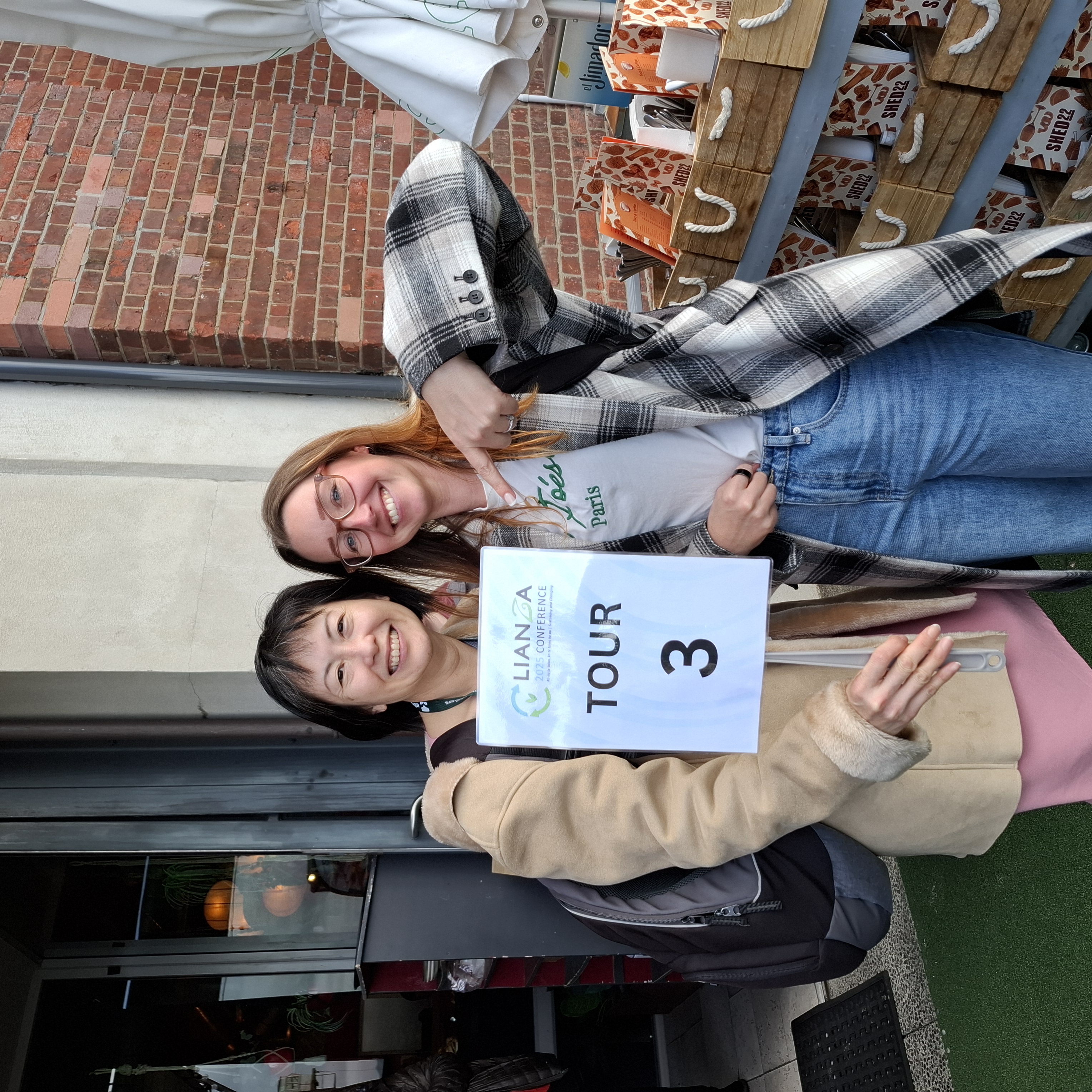
I joined the Tales and Tour 3 on the Thursday and enjoyed visiting Hutt Libraries Moera Library and Naenae Library and Community Centre. I connected with other librarians over some yummy kai during lunch at the Shed 22. It was a wonderful opportunity to view rare 18th-century collections, interact with librarians from the Te Aka Matua Research Library of Te Papa Tongarewa, and visit the Wellington Museum.
My sincere thanks to LIANZA and the conference committee for their outstanding mahi in delivering such a meaningful and empowering conference. The experience deepened my understanding of the profession and inspired me to get my CertLIANZA.
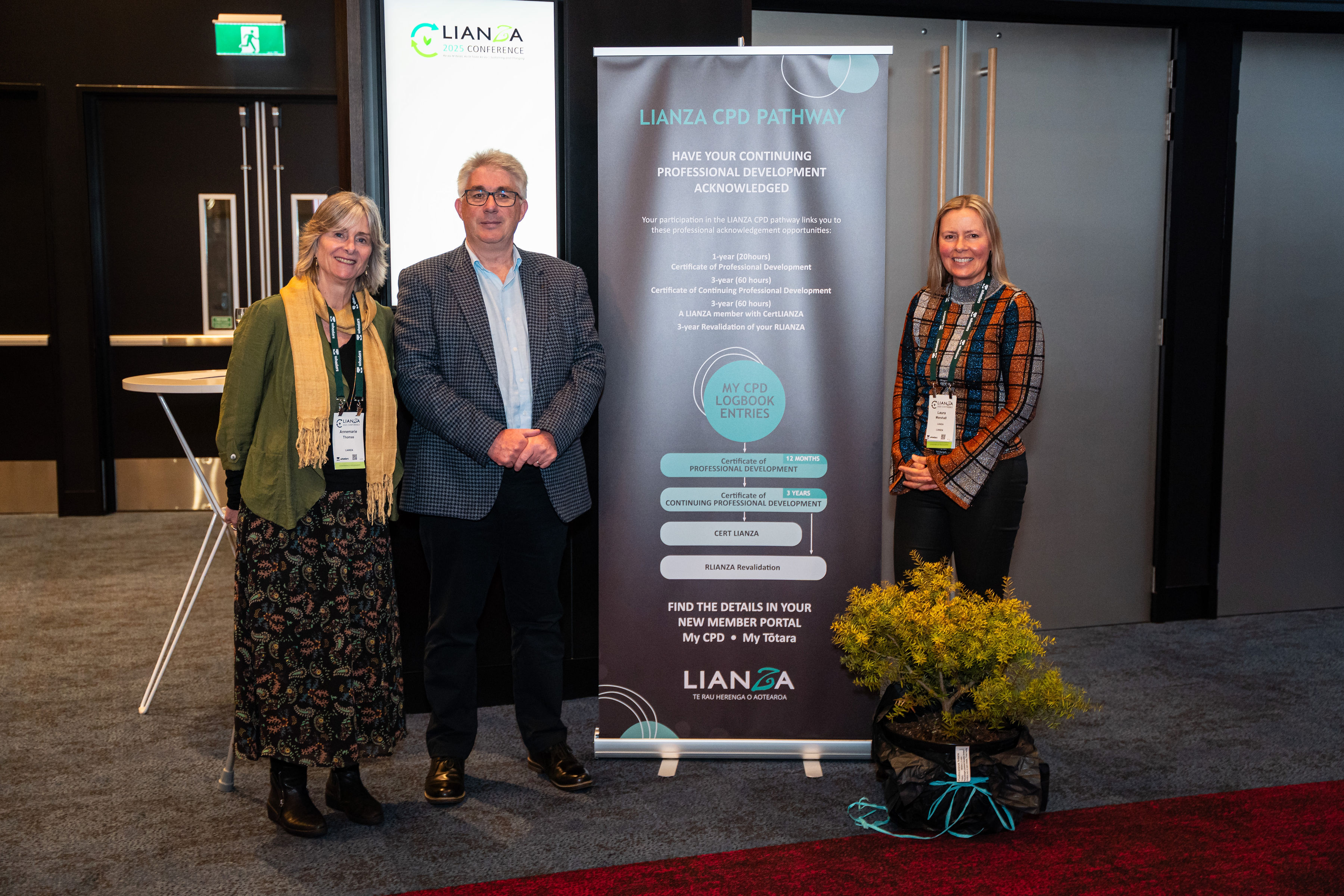
The launch of LIANZA's CPD Pathway from left: Annemarie Thomas, Ian Littleworth and Laura Marshall.
Nur Kamarudin, Puke Ariki
I had the privilege of attending the LIANZA Conference for the first time, thanks to the generous support of the LIANZA conference grant. It was a valuable experience that allowed me to connect more deeply with the profession and hear from a wide range of voices across the library and information sector in Aotearoa New Zealand. I found the experience very inspiring and would definitely encourage others to consider going in the future. There were so many inspiring sessions throughout the conference, but I’ve picked just a few highlights that really stood out to me.
Alola Robertson from Auckland Council Libraries shared a heartwarming and practical initiative from Auckland City Libraries, where mobile libraries are used to meet communities in social housing directly where they live. These mobile library services create natural third spaces—where neighbours meet for the first time, children build friendships and social skills, and isolated residents find connection. What really inspired me was the emphasis on consistency to build trust, on respect for community space and time, and on fitting into people’s lives rather than expecting them to come to us.
LJ Jennens from Whangarei District Libraries lightning talk was one of my favourites. I absolutely loved the idea of a night time library event designed for ‘social introverts’ — such a thoughtful and inclusive concept. The use of a low-stimuli sensory room, and how the event evolved through partnerships with local festivals, really showed how libraries can be both responsive and creative. I appreciated the honesty around challenges like staffing and security, but also the commitment to making space for people who might not feel comfortable in traditional settings.
Another interesting talk was by Marion Kroukam from Hauraki District Council. She gave such a thoughtful and personal talk about cultural sensitivity and belonging in the library profession. Marion acknowledged how heavy the topic can feel but framed it in a really practical and empathetic way, using a tool called KISS—Keep, Improve, Stop, Start. As an immigrant librarian myself, I found this approach incredibly useful for both immigrant and non-immigrant colleagues. For non-immigrants, she encouraged keeping curiosity and care alive, improving long-term engagement, stopping assumptions and diminishing stories, and starting practices like anti-gossiping and holding space. For immigrants, she advocated for self-kindness, intentional belonging, and active cultural learning, while also challenging stereotypes and negative self-talk. I especially loved her reminder that all of this ties back to Te Tiriti o Waitangi, that is through partnership, participation, and protection.
Mandy Henk’s session was another one of my favourites. She spoke about countering mis & dis information, and honestly, she was fantastic. I loved her honesty in saying that things are not going well, and that the rise of generative AI, attacks on experts, and collapse of trust are real threats. What stood out to me was her belief that this is OUR problem as library and information professionals. We are trusted, we are skilled, and we are already on the frontlines. I found her emphasis on lateral reading—asking who is behind the information, what the evidence says, and what others are saying, is practical and something we can all apply. She’s such an amazing speaker, the session flew by!
On the final day, I joined Tales and Tours 5. My favourite stop was Wellington Girls’ College. I was blown away by the creativity and care that went into the library’s design. The space was full of thoughtful, student-centred touches, from the quiet study room with a no-phone policy to the personality-based reading quiz. I loved the inclusion of student-made zines, the jigsaw puzzle corner, and mindfulness colouring. The AI Q&A display was such a clever way to spark curiosity. It really made me think about how libraries can support not just learning, but wellbeing and identity.
Overall, the LIANZA Conference was truly an unforgettable experience. I left feeling inspired, energised, and proud to be part of such a passionate and forward-thinking profession. I would also like to say a special thanks to Angela for buddying me up with Amanda-Jane from Western Bay libraries. She was so helpful, kind and generous in helping me navigate my first conference experience. I truly appreciated all the support that I have received.
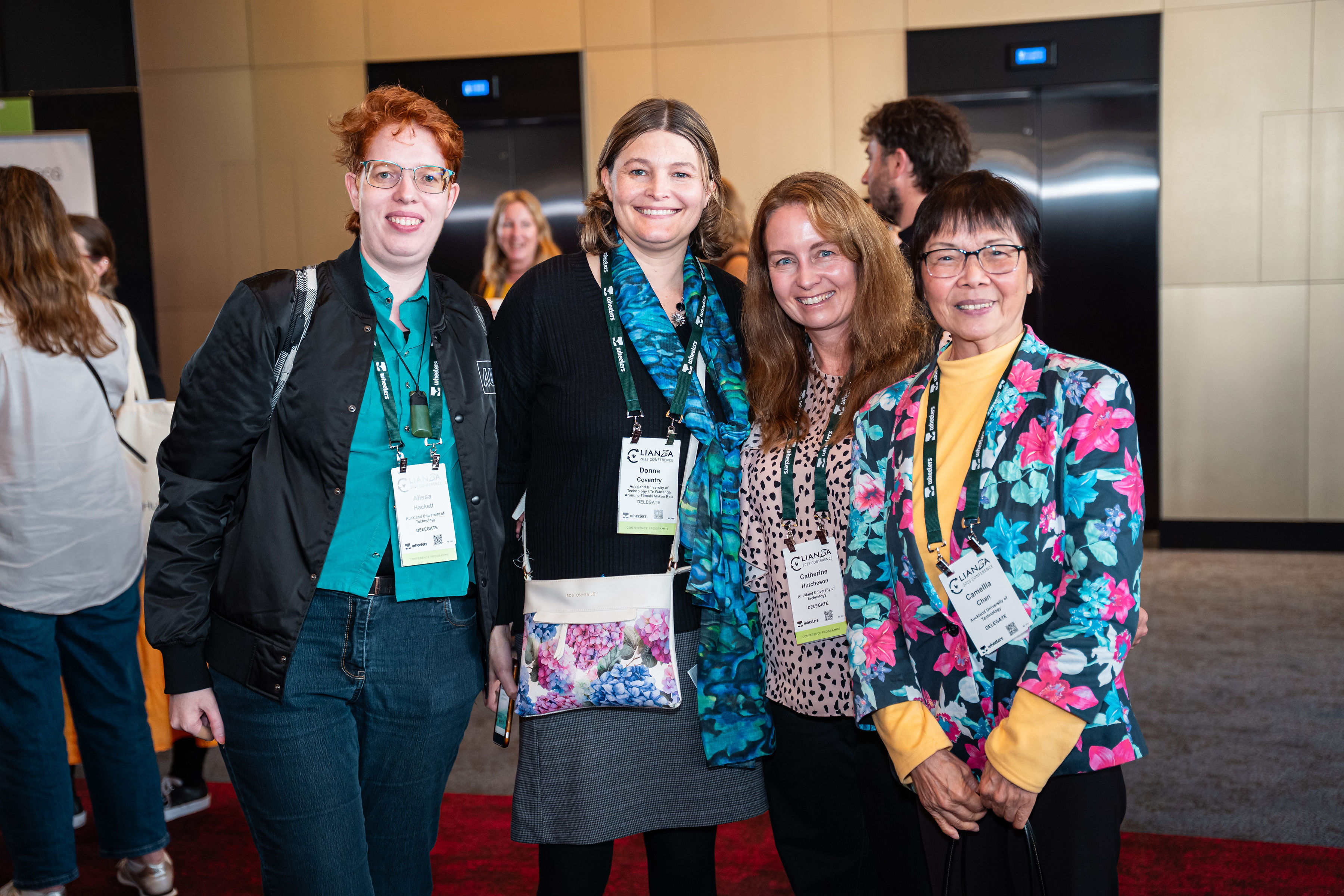
AIT Libraries team: Alissa Hacket, Donna Coventry, Catherine Hutcheson and Camellia Chan.
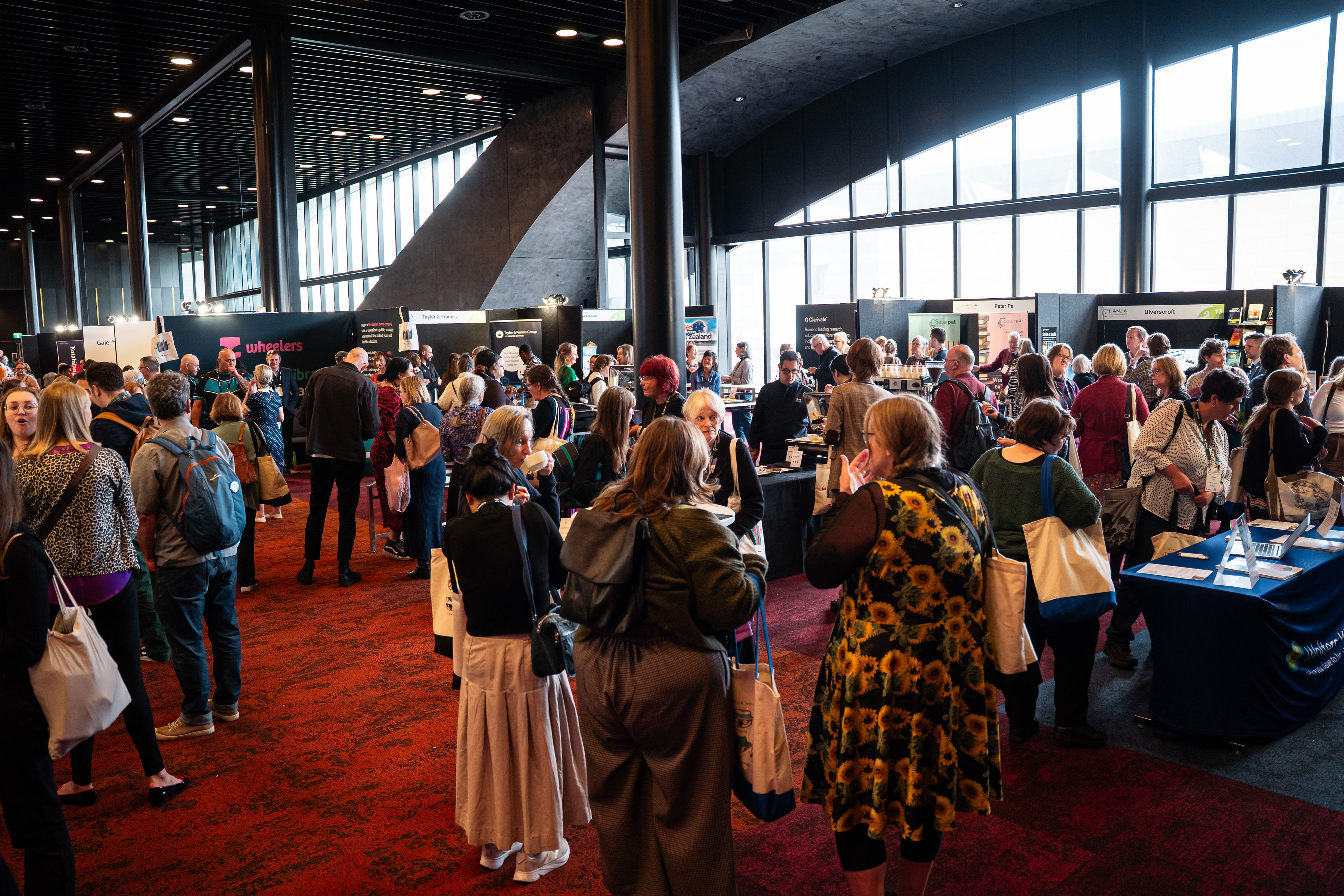
Exhibitor area at LIANZA 2025.
Leasa Fitzgerald-Leslie, Wellington City Libraries
I attended the LIANZA Conference with a particular interest in improving our bicultural visibility and ensuring that Māori feel welcome in our library spaces. With this focus, I selected sessions that explored bicultural practice, cultural engagement, and innovative approaches to library services. I also selected a few to attend that just sparked my interest, and to broaden my professional learning and gain fresh perspectives.
I am doing a graduate certificate in Library and Information Studies this year, so I chose some talks to complement it. The variety of topics over the two days of talks meant you can do both, and I think you can have a richer experience because of it.
I attended papers on: library services for Māori, the role of non-Māori as allies, and indigenous voices in picture books, and the Kōrero session: All the People Come Together. These sessions provided valuable insights into how libraries can authentically support Māori communities and incorporate te ao Māori perspectives into everyday practice.
To broaden my professional learning, I attended several lightning talks, including: Omahu School Library Rebuild – on community-led design and student engagement; Verifying Courses– exploring challenges and approaches to course validation; Nurturing the Vine– on supporting professional growth and mentorship; and Lonely No More– focused on building relationships in special libraries.
In addition, I attended papers that helped build my understanding of sustainability and library management on building sustainable collections, library builds, developing a classification system for Kohikohinga Māori and keeping work moving during a budget crisis.
Networking is an essential part of attending any conference. Some of the most valuable moments came from informal conversations. Taking time to chat while waiting in queues for coffee, lunch, or at the exhibition stalls led to engaging discussions with colleagues from across the country. The atmosphere at the LIANZA Conference makes it easy to connect. Everyone is there for the same reason and is keen to share ideas, successes, and challenges.
The visits to local libraries were fascinating, I enjoyed seeing different ways libraries operate. As a Wellington local, I tried to find a tour that included as many places as possible I hadn’t been to before. I attended Tales and Tours 1 which included: Te Papa’s research library, Wellington Museum, Parliamentary Library, and Te Pātaka Kōrero at Victoria University.
A personal highlight was seeing a Zine at the Parliamentary Library, 'The McGillicuddy Serious Party Manifesto', which I have a strong recollection of when I was a new voter. If you can attend the third day, I highly recommend it as it is just as valuable as the previous two days.
My Key Takeaways:
- Bicultural visibility must be intentional, supported by strong relationships and cultural understanding.
- Collaboration and open discussion across the sector sparks innovation.
- Conferences offer invaluable opportunities not just for learning, but for building community and sharing inspiration.
03 December 2025
