

Te Whatu Ora Health New Zealand
The Health New Zealand Library and Knowledge Service plays a crucial role in supporting healthcare professionals by providing access to accurate and up-to-date medical information, managing and organising medical resources, and training staff in effective information retrieval.
Health New Zealand librarians assist with research and evidence-based practice by conducting literature searches to support clinical decision-making and evidence-based decision-making to improve service delivery. They are vital facilitators who ensure that healthcare providers have the reliable information needed to improve patient care and outcomes.
Health New Zealand maintains physical, professionally staffed libraries in most major hospitals across Aotearoa, from Whangarei to Invercargill. And it also partners with Otago and Auckland Universities to provide library services to Canterbury, Capital and Coast and Auckland districts.
Navigating a period of disruption and change
In June 2022, the New Zealand health sector was restructured. This involved replacing 20 District Health Boards (DHBs) with a single national organisation called Te Whatu Ora Health New Zealand. The restructure was driven by the need to address fragmentation, inefficiencies, and disparities in healthcare delivery across the country. The DHB model had led to variability in service quality and access, with challenges in coordination and resource allocation.
By centralising governance under Health New Zealand, the government aimed to create a more unified and equitable health system that could standardise care, improve integration between services, and enhance strategic planning and resource management. Early outcomes of this reform include streamlined decision-making, better national oversight of health priorities, and an increased focus on addressing inequities. However, the transition has also presented challenges related to change management and ensuring local community needs continue to be met effectively.
Subsequent internal reviews and further restructuring have focused on identifying cost efficiencies and budget savings in a constrained national budget environment. The focus in 2024/2025 has been on strengthening frontline services, prioritising identified health outcome targets, decentralising decision-making to regional and local leadership, and, where appropriate, restructuring and downsizing of staff numbers in support services.
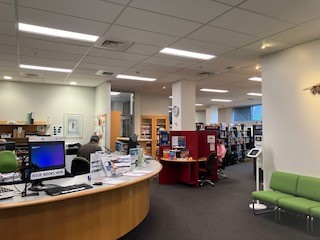
North Shore Hospital Library
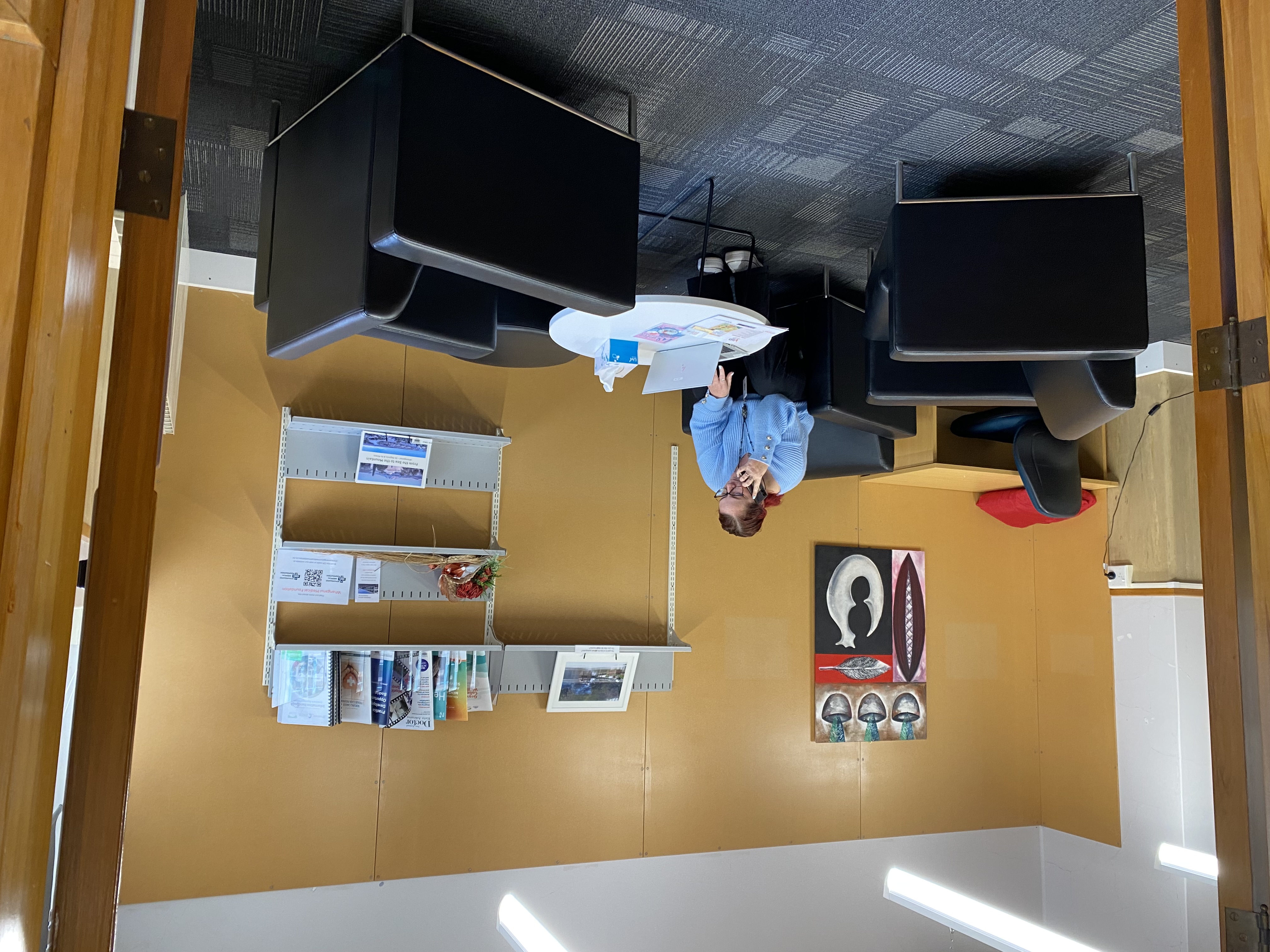
Whanganui Hospital Library
Creation of a single unified national library service
Within this challenging context, Health New Zealand librarians advocated for the creation of a single unified national library service. In 2022, a white paper jointly prepared by members of LIANZA Health SIG was circulated to the newly created Health New Zealand executive team for consideration. The vision for a national library service was well aligned with the vision of the new organisation and was endorsed.
In September 2023, a group manager for the newly created Library and Knowledge Service was appointed. In the first half of 2024, three regional team leaders were appointed to assist the group manager and provide support to local librarians at each of the major hospitals across the country.
Historically, there had been strong collegial collaboration and co-operation between the various DHB librarians. Well-developed systems for document exchange, consortial procurement agreements and a bi-annual professional development event had been in place for many years. The new leadership team was able to leverage the existing structures and relationships and to build upon this culture of collaboration.
In June 2024, a single national resource budget was confirmed for the 2024/2025 financial year. In October 2024, procurement decisions were finalised for a new national e-resource collection that would be accessible via a single national Discovery portal (Ebsco EDS) across the organisation from 2025. New ways of working across the Health New Zealand library team were enabled by the deployment of a Microsoft Teams environment and the adoption of RefTracker to manage workflows.
From January 2025, OpenAthens was deployed to give all Health New Zealand staff off-site and remote access to the new national library collection. Integration of LibKey Nomad, Google Scholar, PubMed and READ QxMD into our Ebsco Discovery holdings enables access to our collections for all Health New Zealand staff from anywhere on the web.
The national library service was also instrumental in establishing and now managing a new national publicly available Health New Zealand Research Repository hosted on FigShare.
Most recently, in August this year, a new library resource portal was launched and is available via OpenAthens for health professionals in the community. This library portal enables access to point-of-care tools, research databases, and full-text access to e-texts and journal content for GPs, community, residential, and aged care nurses, community pharmacists, allied health professionals, and others across Aotearoa. Registration to access the portal for community health professionals is available via the Health New Zealand website and also via Health Pathways.
At a time of major organisational disruption, the pace and scale of change for the library team were both ambitious and challenging. It is a credit to the excellence and dedication of the library team that we were able to deliver on the vision first formulated in early 2022. However, it has not been without its challenges.
In 2024, there were significant reductions in our resources budget, exacerbated by an exchange rate drop of more than 10%. Our staff size nationally has reduced by about 20%. By allowing vacancies not to be filled and to be ‘given up’ over the last two years, we have been able to meet targets for resizing without staff being disestablished. The Health New Zealand library team currently comprises 30 staff, 27 FTE. The Library and Knowledge Service is part of the Evidence and Pathways portfolio within the Planning, Funding and Outcomes Directorate of Health New Zealand. The resources budget, excluding staff costs, is approximately $7 million per annum.
The restructure also had a significant impact on the arrangements previously in place with the two universities. New contracts with each university were jointly prepared in 2024, establishing a new relationship whereby Health New Zealand managed collection resources and access, with the university library teams delivering local library services. A sign of the goodwill and agility of our university partners is that the new structure is already well established and will be renewed for 2026 largely without change. Indeed, by inclusion of the academic library staff in our Health New Zealand team meeting structure, we have been able to build relationships and grow a deeper understanding of the broader health sector amongst the combined workforce.
Looking ahead
2026 promises to be a year of consolidation. However, we are also prioritising a migration to a single national library management system and, along with the wider organisation, putting an increased focus on how we can work with AI to enhance our service.
It has been quite the journey. Challenging. At times difficult and frustrating. But ultimately rewarding. The shift to a national model has allowed us to deliver services and resources equitably at scale across the country, supporting better health outcomes for our communities.
Peter Murgatroyd is the Group Manager Library and Knowledge Services at Te Whatu Ora Health New Zealand. Before Te Whatu Ora was established, he was the Library and Knowledge Services Manager at Counties Manukau DHB. Peter has held roles at the National Library, the Secretariat of the Pacific Regional Environment Programme and the University of the South Pacific. He is a LIANZA Fellow.
01 September 2025
