The much-awaited Te Matapihi ki te Ao Nui, Wellington City’s central library, opens its doors to the public on March 14. The new space now has 30% more public space, 30% less carbon, and was 30% cheaper to develop than a new build.
Four years of construction, 560m3 of concrete, 1,400 tonnes of structural steel, 22,000m of welding rod, 877,000 hours worked on site and 1,600 workers inducted on site. That’s no mean feat. And then the additional library kaimahi hours. 400,000 books were returned to the building, then sorted and shelved.
In 2020, work began on Te Matapihi ki te Ao Nui and included consultation with the Wellington public, mana whenua, and other key stakeholders. The feedback was clear: Wellingtonians wanted Te Matapihi to be first and foremost a safe, resilient, and future-proofed library, a centre for public knowledge, and a multipurpose, multi-use resource for the community.
“On entry and from first breath in the new building space, the aim is for the people of Pōneke Wellington to see themselves reflected in both the building design, ngā rauemi (resources) and the service design for Te Matapihi ki te Ao Nui and to breathe in the many layers of consideration given to our community and serving the city,’ says Wellington City Libraries’ Deon Knox.
Te Matapihi ki te Ao Nui is a modern, uniquely Wellington library that celebrates the history of Pōneke with mana whenua narratives woven throughout. It brings Nōku te Ao Capital E, Wellington City Archives, and the library back into the same central site.
Te Matapihi’s design was inspired by te taiao – the natural environment, with specific reference to the flora and fauna of the forest floor, which flourished for centuries along Pōneke’s waterfront. Athfield Architects, led by Zac Athfield, and Tihei Limited, led by designer and artist Rangi Kipa, bought elements of te taiao to life to create an inclusive and accessible community space for all.
“From books to study areas, exhibitions, cultural experiences, maker spaces and school programmes, this will be a place for the whole community to enjoy, engage, and learn,” said Wellington City Council’s Chief Operating Officer James Roberts.
The building has been developed to the New Zealand Green Building Council (NZGBC) 5-star rating, indicating a high standard of environmentally sustainable design.
“The biggest change is the sheer amount of natural light. It feels far more open, which also makes it feel bigger. The concrete panelled sides have been replaced with floor-to-ceiling glass. You lose a bit of that cosy, closed-in feel, which I appreciate for a reading space, but it feels brighter and happier,” says Joel Macmanus in The Spinoff.
The new tomokanga (entranceways) also make the building feel more open, with four entrances now instead of two. This was a design priority for mana whenua: more entrances along with significantly more natural light would make it feel like a space welcome to all.
“The approach for Te Mataipihi ki te Ao Nui has been to walk into the future, bringing both the past and what is best in the most current evolution of library services and spaces. As one integrated ‘living room’, familiar and comfortable, and where we expect visitors may explore the building and discover moments that will both excite and surprise, again and again,” says Deon Knox.
Te Matapihi includes a new children’s library in a brighter, friendlier, elevated space on the ground floor. A maker space, with resources for everything from 3D printing to painting, weaving and carving. A permanent youth space that, unlike the previous iterations, won’t be constantly disassembled for author talks and other events. Also included is the new home of Nōku te Ao Capital E, “where the next generation will begin their journey of creativity”. A ground-floor cafe, two art galleries, and, on the top level, a dedicated home for Wellington City Archives.
It will offer spaces for conversation, learning, knowledge sharing and transmission. Deon Knox says, “We wish to acknowledge the important place of the written word as well as our own indigenous oral traditions for knowledge transmission. In this way, kōrero is very central to the library space, the written and the spoken word. Moments of conversation may arise naturally anywhere in our library spaces, as does a puna (spring), to provide life and sustenance”.
Tohi Tāngaengae reawakening ceremony led by mana whenua.
Hohaia’s Ngā Tai o te Ao Mārama through the windows.
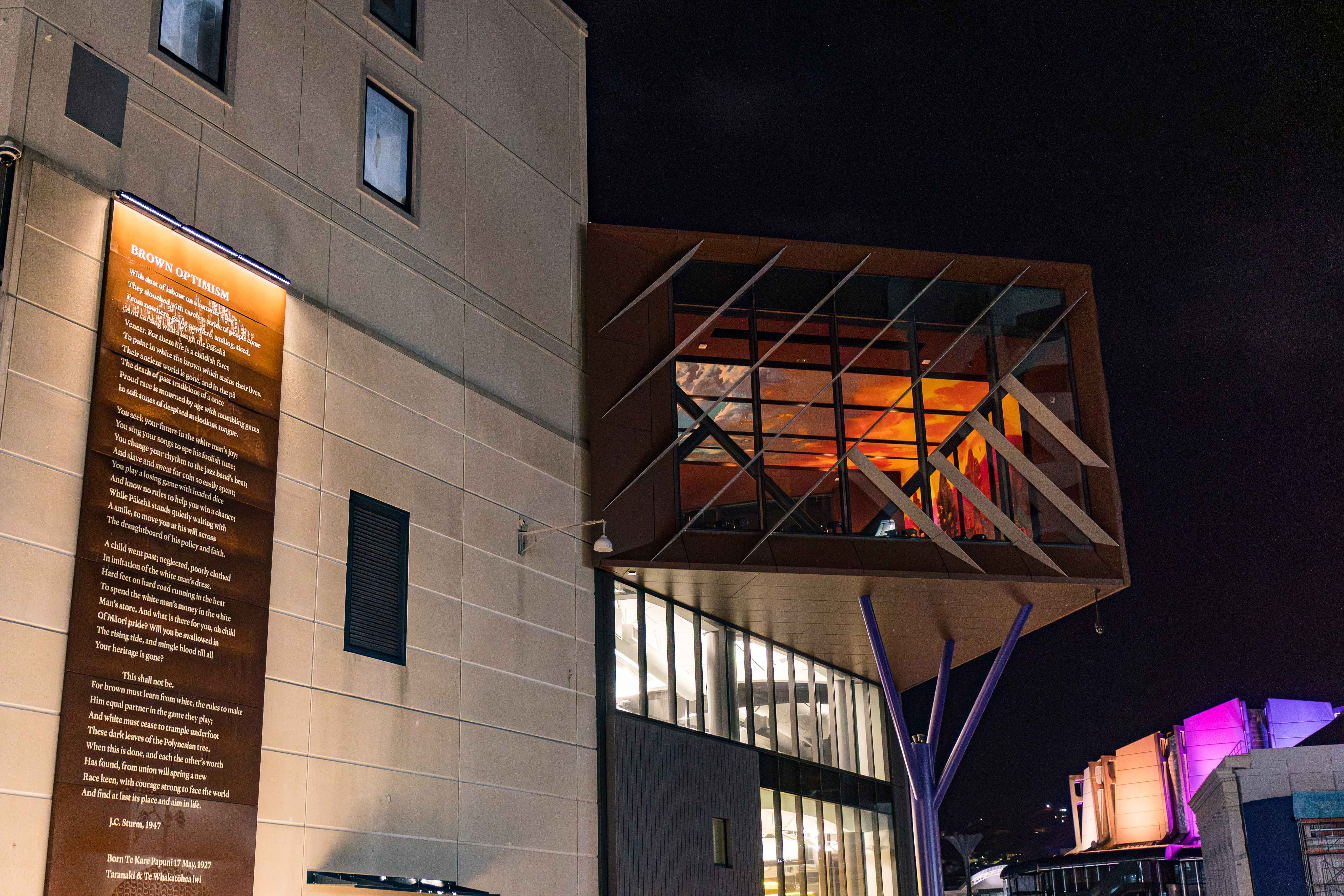
Significant rawa (artwork) populate the building. On the exterior of the building is the poem Brown Optimism by JC Sturm (Taranaki iwi, Te Āti Awa, Ngāti Ruanui, Te Pakakohi, and Te Whakatōhea of Ōpōtiki mai Tawhiti) – a powerful, political statement that demands equality for Māori and addresses the challenges of biculturalism.
“When people step into Te Matapihi ki te Ao Nui, they should feel the presence of mana whenua and understand the deep histories of this place. This is about more than design, it’s about ensuring our tamariki, our kaumātua, and all Wellingtonians see themselves and their stories in this space.” says Rangi Kipa, Tihei.
Ngā Tai o te Ao Mārama by Ngahina Hohaia (Taranaki iwi, Te Āti Awa, Ngāti Ruanui, Ngāti Moeahu, Ngāti Haupoto– Parihaka) hangs above the Victoria Street entrance. It is a monumental piece depicting a giant mycelial fungus that “represents ideas of vibrational energy, the currents of tides, the movement of water and air, and how that manifests itself in the forms of all living things”.
The Harris Street entrance is marked by Ko Rangi, ko Papa by Wiremu Barriball (Te Āti Awa, Ngāti Raukawa, Te Rarawa), a tā moko artist and the lead guitarist for Katchafire. Again, it focuses on fungi and microorganisms.
Ngā Pou Ruahine is a newly dedicated space for performance and gathering, offering a sense of reflection and connection for visitors to the wider building while remaining distinctly its own. Stretching along the side wall and the ceiling of Ngā Pou Ruahineis the strikingly colourful Earth Mothers by Darcy Nicholas (Te Āti Awa, Ngāi Te Rangi, Taranaki, Ngāti Ruanui, Ngāti Hauā), which represents “the tapu of the female principle and the many children wāhine bring into creation”.
The publishing community has levelled criticism at the library for removing some of the on-site collection. However, as Gisella Carr noted at the time (in Georgina Campbell’s article, 23/11/2022), much of the old central library was dedicated to storage, with narrow, high shelving.
“This evolution of our library services has meant that the floor space for physical collections is smaller than it was in 2019. Our librarians have curated the collections to retain the breadth and depth that Wellingtonians value, while also offering moments of delight and serendipity. We have the benefit of increased stack storage to preserve the long tail of important or delicate items for future generations of library users,” says Wellington City Libraries’ Kathleen Lockett.